 |
October 30, 2026 · 6 min read |
The story |
The diesel squeeze |
Russia locked its diesel at home, drones broke its refineries and Middle East exports fell. America's refiners earned the gap. On October 27 the market started pricing the end of it. |
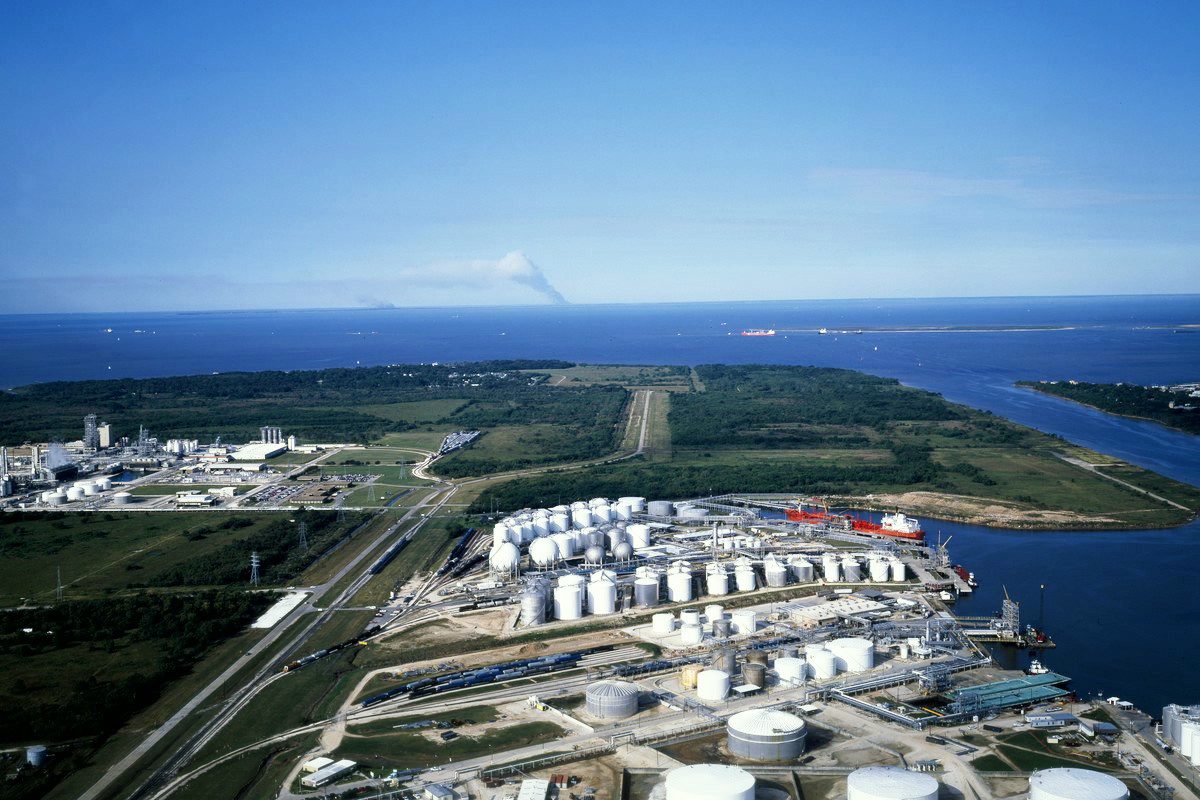 |
Diesel moves the trucks and trains behind almost everything Americans buy, and this year there has not been enough of it. In July Russia stopped its own refiners from exporting diesel, and on September 30 it extended that ban to October 31. Ukrainian drones had already damaged its refineries: the International Energy Agency says Russian diesel output and exports slumped in recent months. The Middle East lost exports too. Together, the IEA says, net diesel exports from the Middle East and Russia fell by more than 60 percent in a year. |
The price followed. The US average for a gallon of diesel hit a record of $6.53 on September 22. On October 28 it was about $6.35, against about $3.67 a year earlier. Trucker Old Dominion reported paying 70.5 percent more per gallon in its second quarter than a year before, with no hedge. |
Where it landed |
The refiners were paid for the gap |
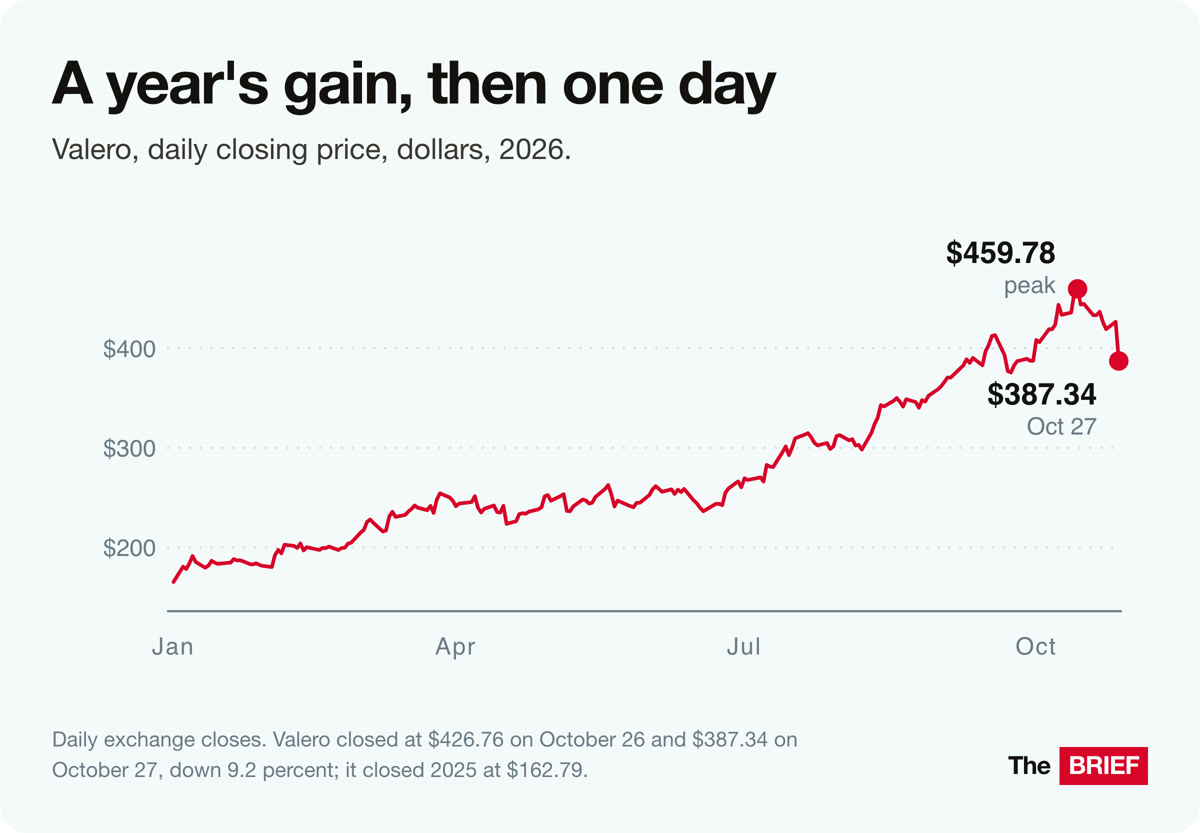
A refinery does not earn the price of oil. It earns the gap between the crude it buys and the fuel it sells. At Valero that refining margin was $39.24 a barrel in the third quarter, against $13.14 a year earlier, and the company made $6.8 billion, up from $1.1 billion. Before October 27, Valero's stock had risen about 162 percent this year. Marathon Petroleum was up about 189 percent and Phillips 66 about 124 percent. |
Then the gap started to close |
On October 9 the US Treasury issued a licence allowing transactions in Russian diesel, including importation into the United States, until April 7, 2027. The President said Russia would supply over 300,000 tons, which is less than one day of what America uses. The next day Moscow partly lifted its ban, releasing 500,000 tonnes for export. |
On Tuesday, October 27, Valero closed 9.2 percent lower, Marathon Petroleum 7.4 percent and Phillips 66 7.0 percent. Heating oil futures, the US diesel benchmark, fell 2.8 percent, and crude 1.8 percent. Across the three companies, that is about $28.65 billion of market value in one session. The same day the energy secretary told CNBC that more Russian diesel was quite possible. No source links his remark to the fall, and we do not either. | |||||||||||
|
The mechanism |
Why the stocks fell three times harder than the fuel |
Valero fell about 3.3 times as far as diesel futures did. Marathon and Phillips 66 fell about two and a half times as far. A refiner's value rests on the margin it expects to earn, not on today's barrel, and the margin is what a reopening supply route takes away. The market was not selling oil on Tuesday. It was selling the gap. |
What the refiners themselves said, five days earlier |
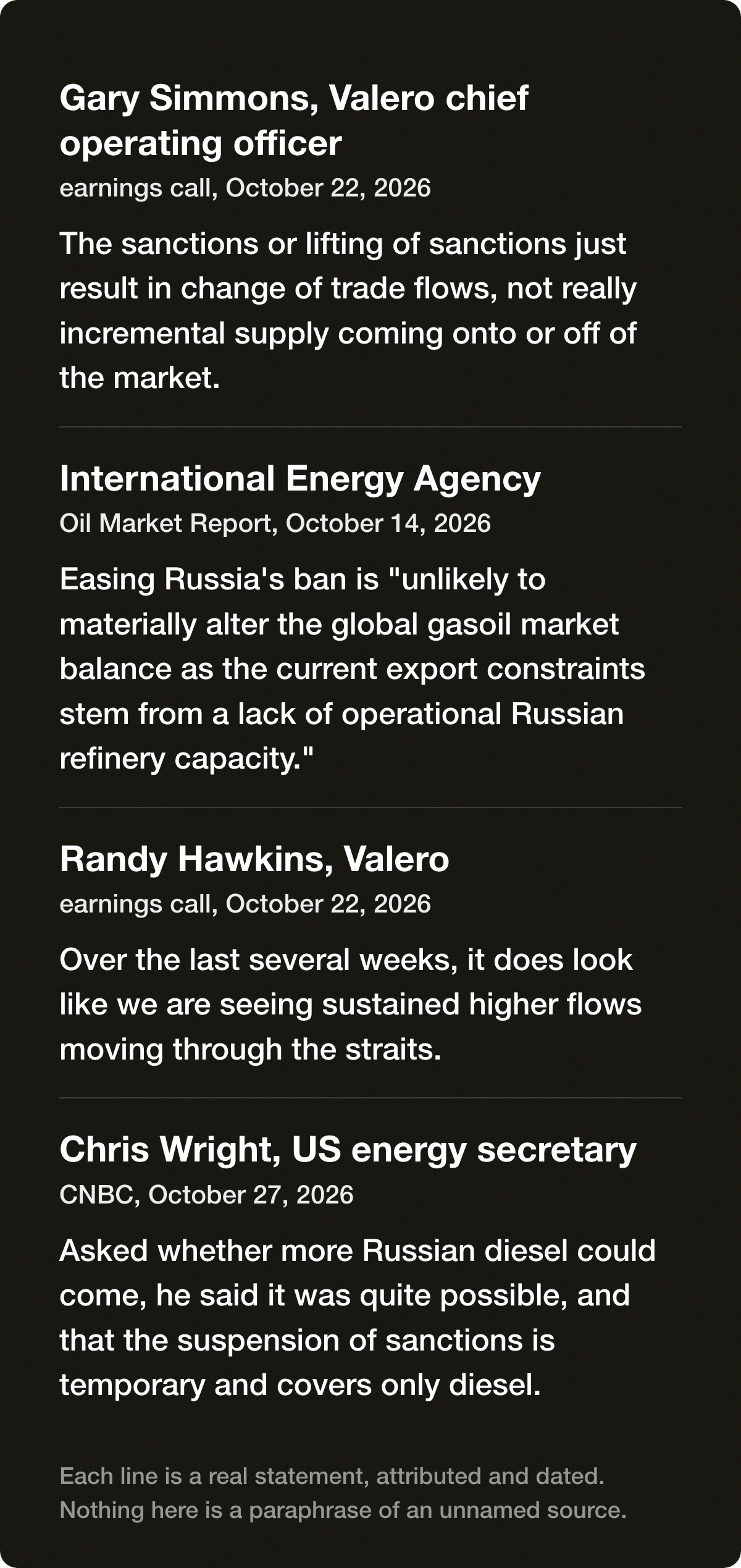
On Valero's October 22 earnings call, its chief operating officer said lifting sanctions changes trade flows, not really incremental supply, and that some of the recent pressure on margins came from headlines about strategic reserves and Russian sanctions. Valero put Russian refining offline at about 1.4 million barrels a day. The IEA says the same thing from the other side: easing Russia's ban will not change much, because what limits Russian exports is a lack of working refinery capacity. |
 |
What they are saying |
Read the first two together. Valero's operator and the IEA both say the limit is refineries, not permission. The third and fourth point the other way: more crude is moving through the straits, and Washington says more Russian diesel could come. |
 |
What to watch |
What changed on October 29 |
On October 29 Reuters reported, citing two people familiar with the discussions, that Russia will extend its diesel export ban to the end of the year while letting some companies ship under quotas. Those quotas would quadruple to 2 million metric tons in November, about half a million barrels a day. The same report says Russian refinery use rose 25 percent from the start of October after drone attacks subsided. None of this is in a government order yet: the current ban still ends October 31, and a new order is expected in early November. |
The number that decides it |
Every week the Energy Information Administration counts America's diesel and heating oil in storage. In the week to October 23 it was 102.8 million barrels, down 8.3 percent on a year, and the lowest for that week of the year in EIA records going back to 1982. | |||||||||||
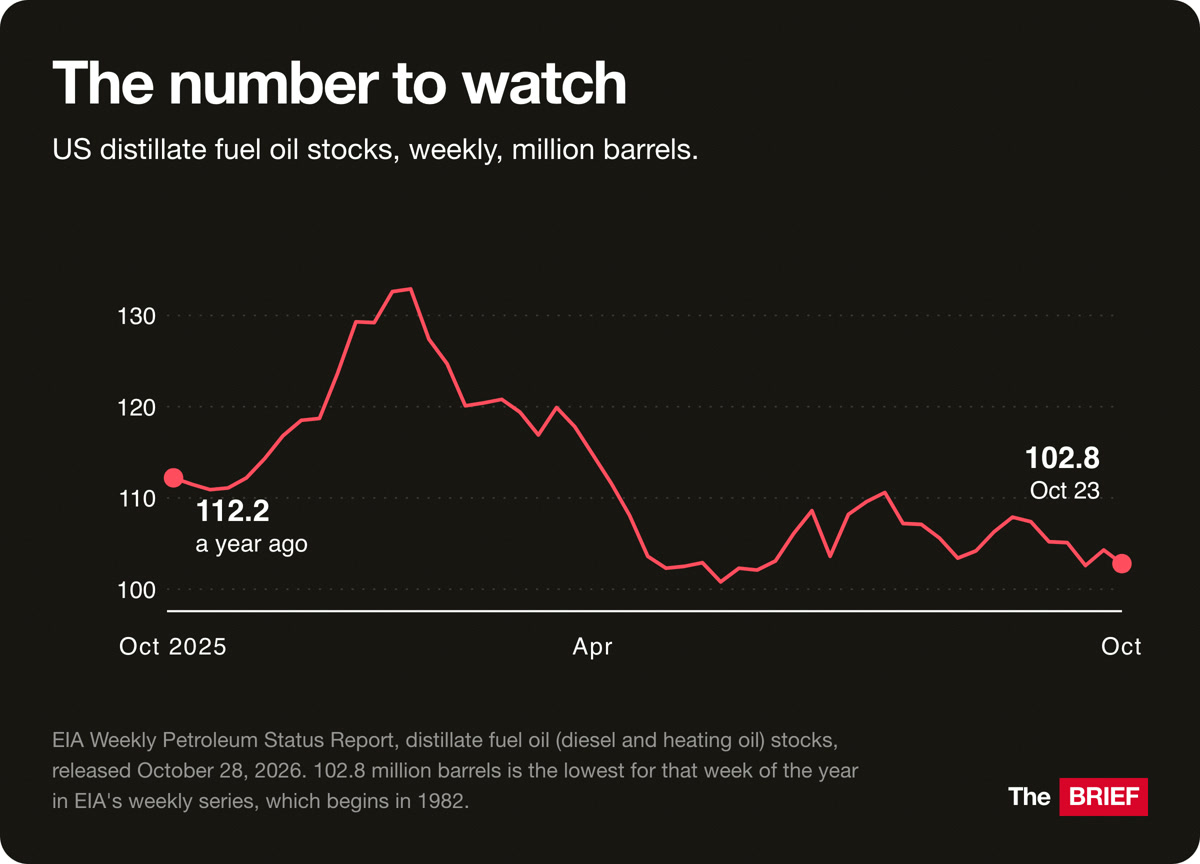 | |||||||||||
The next count is due November 4. It is the one number here that shows whether Russian quotas, American licences and returning Middle East flows are actually reaching American tanks. | |||||||||||
| |||||||||||
What we make of it |
Three things. First, Tuesday was a vote on the shortage, not on oil. Fuel barely moved and the companies that earn the gap fell three times as hard. That only makes sense if the market thinks the gap is the thing at risk. | |||
Second, the refiners and the agency agree on the limit. Licences and quotas move paperwork. Refineries move barrels, and Russia's are only now coming back, by its own account and Reuters' sources. If Russian refinery use keeps rising, the quotas will have fuel to fill them. If it stalls, the extra permission changes little. | |||
Third, the cost of the squeeze lands on the people who pay for diesel, and it lands every week the stocks stay low. That is why the storage count matters more than any headline from Moscow or Washington. If the weekly number starts to rebuild, the gap has room to shrink. If it keeps falling, the gap stays wide, and so does the price at the pump. | |||
The Brief goes out every Sunday morning. | |||
How was this issue? | |||
| |||
 | |||
RollOutInvestor, Calgary, Alberta, Canada | |||
General research, published to every reader on the same schedule. Not personal advice and not a recommendation to buy or sell any security. |